


El flamenco has many sources from which to collect its lyrics, from its origins until today. We are used to seeing how there are many flamenco verses that come from more or less anonymous authors, lyrics written for the cante expressly, but we also know the lyrical role played by the ballad, the songbook, folklore, proverbs, Hispanic American poetry, etc., or cultured or authorial poetry – the Lorqueñas of Pastora, the four muleteers de Marchena, the sonnet of Borges of the Goatherd, New York Aurora de Enrique Morente, etc-.
One of the possible encounters or reunions is that of Sephardic poetry, the songs – lyrics and music – of the Jews expelled from Sepharad, as they said to the land of our country, in 1492, which produced an exodus through different countries where, however, they have preserved the language of that time. I know some, like the tangos of the chavico who sings Estrella Morente -CD Street of the air, 2001–, which I had at home on a cassette tape dedicated to those songs that I studied in Philology and liked a lot. We can listen to them at this link:
But an attention as extensive as a full album, Exodus, from the flamenco, we don't know her. The members of the group have dedicated an interesting and innovative album to this Alxaraf, formed by three good artists: the singer Vicente Gelo, the guitarist Tino Van der Sman, here in this work with the collaboration of the percussion of David Chupete, the double bass of Gal Master, the bouzouki of
Socrates Mastrodemos, and the choirs of Paula Ramirez, Hope Garrido, Jeromo Segura y Ale Villaescusa, and palmas and hustle and bustle of Jesus Rodriguez, Juan Thomas de la Molia, Cry, George the Cuban.
They rescue and cover nine songs, converted here into canteThey recreate them, because everything is completely within the flamenco and its palos very recognizable: alegrías, tangos, tanguillos, petenera of course, etc. They do it in a subtle and creative way, as they write in the libretto, after intense research and compilation. With the vocal commitment and professionalism of Vicente Gelo, the musical excellence flamenco of Tino and the quality group that accompanies them, the result is more than remarkable.
We can have in this link more information about the group.
«A special, different, very special album flamenco, union of two traditions, the Sephardic and the flamenco, a true example of the availability of the flamencos to not be carried away by laziness and to investigate to have new repertoire, however old, but not old, that is, like the Sephardic, charming songbook»
Linking in this way an oral poetic and musical tradition, the Sephardic Jewish one, and the flamenco one, they bring us closer to a world of more or less successful love lyrics, of mischief, of advice to a daughter, of ways of cooking, and some lyrics are confused, since they introduce some of the heritage flamenco Very often sung, such as “In January there are no carnations…”, “Where are you going, beautiful Jewess…”, “I fell in love with an air…”, “A handful of brave men”, “Windows to the street…”, etc. Everything is united with simplicity, quality, mastery, beauty.
We highlight some of them. Goodbye Kerida, cut 2, dynamic and beautiful, by bulerías, is a plaintive lyric of desperate love, as in this fragment:
Goodbye, goodbye dear,
I don't want life,
you made it bitter for me.
We can listen to it in this link of the live recording:
For tangos, cut 4, Nights nights, through tangos, recreates the nights of lovers, with a call to carpe diem, the enjoyment of the moment:
Night, night, good night:
nights are for falling in love,
Oh, what nights of lovers.
Oh, what!
I am also attracted to the version of the petenera, which one of the theories about its origin takes to the Jewish world. Here they sing the lyrics «Y a la una yo nací / ya las dos me engrandecí…» together with others such as «¿Dónde vas, bella italiana…?», all with varied rhythms including the atangados and the South American airs. Without a doubt, a beautiful result. Or the following cut 7, Eggplant stews, por bulerías, a fresh, mischievous version of this song that explains the ways of cooking. It contrasts with another special song, of a contrary nature to the previous one, since the 8th, The rose blooms, addresses the theme of suffering for love, with the symbol of the rose, with a slower tempo and melancholic background, with bright dots throughout the theme:
The rose blooms
in the month of May
and my soul darkens
suffering from love.
The rest, of course, are all very well interpreted. We find ourselves, in this way, with a special, different, very flamenco, union of two traditions, the Sephardic and the flamenco, a true example of the availability of the flamencos to not be carried away by apathy and to investigate in order to have new repertoire, however old, but not old, that is, like the Sephardic, charming songbook. Congratulations for this effort of such a notable result with the wish and the request, to whom it may concern, that this work can be heard live in many places.
En expoflamenco They presented their album in June 2024, where they comment that it is a work of musical archaeology that does not pursue a pairing but rather a dialogue between the two cultures.
And here is the link to listen to the full album: https://alxaraf.bandcamp.com/album/exodus
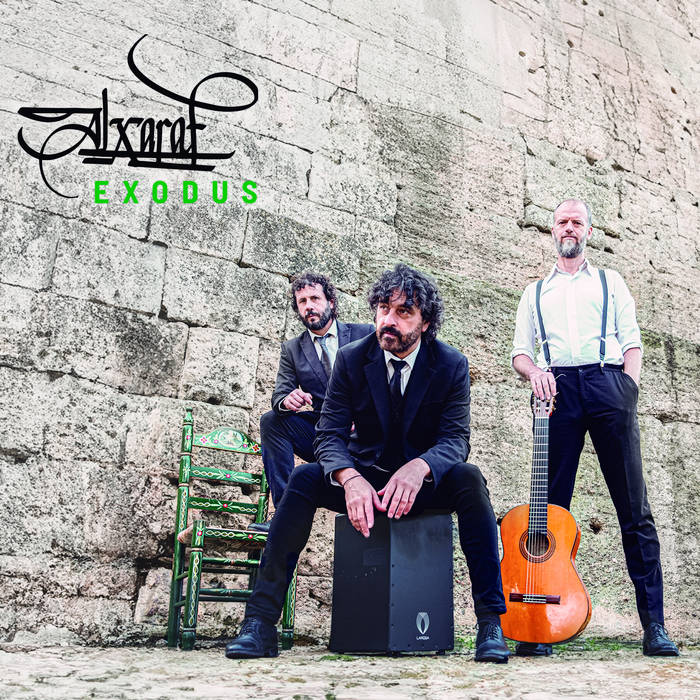
→ Alxaraf Group, CD Exodus (Digitaldos, 2024).


