


Lung cancer has been the final outcome of the chunga, the dancer who found the most natural balance of her art barefoot, not so much for health benefits but as a vital necessity.
At your 87 years of age, Micaela Flores Amaya He said goodbye to this world yesterday, Friday, January 3, as confirmed by his own son to a collaborator of the Atresplayer program And now Sonsoles, to which he added the long process that La Chunga suffered during an illness with no apparent solution.
La Chunga, who acquired the nickname in her family environment for being “very black, very ugly and very small”, was the daughter of Spanish parents who emigrated to the French town of Marseille, where Micaela Flores Amaya was born in 1937. A year later the family returned to the barracks in Barcelona, on the slopes of Montjuich, from where she focused her attention on the dance of her cousin, the incomparable Carmen amaya, hence I took it as a reference and approached the dance from a racial and temperamental perspective.
In this sense, La Chunga, whom we were able to meet in The Chinitas Cafe, from Madrid, stood out for performing the dance barefoot, but also for interpreting an expressive language where the passion of the flamenco dancer was distinguished from the new school that prevailed at the time, the solemnity and feminine quietness of the time.
At a young age, La Chunga was already dancing outside bars and at parties until the day a lady asked for her presence at a party. They took her out of the shacks, washed her, combed her hair and put a dress and a necklace on her, since, as she herself confessed, “in my house there was no shower or anything like that and I smelled.”
Her life took a complete turn when she met the painter Francisco Rebes, who discovered her dancing barefoot in improvised street performances. So much so that it changed her life, because not only did he make her his model, but he also introduced her to the intellectual world of the time, which explains why she met Picasso, Rafael Alberti, Jose Manuel Caballero Bonald and even Salvador Dalí, who proposed a very special work, a canvas on which he leaves several tubes of paint. To the sound of the guitar of Ramon GomezLa Chunga dances barefoot on the fabric, spreading the color and thus creating a new art, painting with the feet.
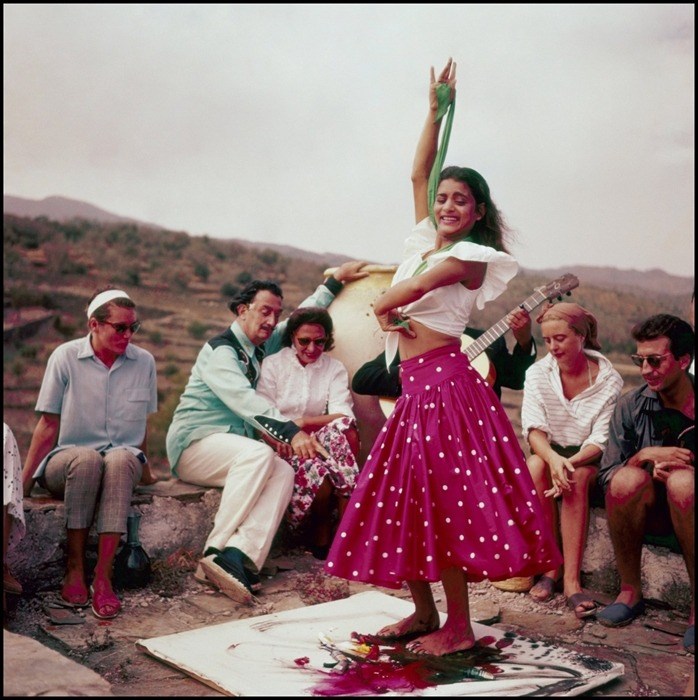
«The artist who was the star of the world of tablaos and who received so many awards, who brought to the world of dance a very unique way of performing it, and who, without academic techniques, embraced the world from the seduction of her intuitive art»
In this regard, it should be noted that La Chunga exhibited her works in Spanish cities such as Madrid, but also at a European level in capitals such as Paris. But we had stayed at the beginning of her flamenco career. And so she is appearing in Barcelona restaurants, such as The snails, from Barcelona, which is where the great noticed her Pastora Empire.
The Sevillian teacher includes our protagonist in the tablao The Scarf, in Palamós, and later incorporated it into the painting he presented in The Corral de la Morería, from Madrid, where both the owner, Manuel del Rey, how many celebrities paraded through it, like the actress Ava Gardner They noticed her with praises that took her not only to Hollywood, but to participate in the prime-time program The Ed Sullivan Show.
The impact that La Chunga caused was confirmed in Mexico, from where she was elevated to the category of one of the most popular artists of the decade 1965-1975. Her fame spread to Spain, where she worked in the Liceu Theatre, from Barcelona, and spread to the European capitals and those of the new continent, where it spread its popularity in places as diverse as the United States, Mexico, Cuba, Venezuela, Argentina and Chile, all at a time when it became visible in the cinematographic world given its dance and interpretive conditions.
It is after participating in the film The last summer, Juan Bosch, when he displays the power of his art in nightclubs and sets up his company, with which he tours the entire country and other international performances that were very famous, such as the Unesco festival in Brussels (1965), or the University of Paris (1968), to return again to the cinema with the Sevillian Antonio en Race law, Jose Luis Gonzalvo, and presented at the opening in 1971 of the The Cordobes tablao, on the Barcelona boulevard.
That very year La Chunga retired from the stage and did not return until 1977, when she occupied the stage of El Café de Chinitas, in Madrid, in order to make her debut with great public reception, participating, in the same way, in the show With caste, Lola Flores, and in the movie Nosferatu in Venice, Mario Caiano, which was filmed in 1986, and which everyone took as a preview of his retirement in the XNUMXs.
And we arrive at the dawn of 2025 to echo in expoflamenco of the news of her farewell. Micaela was a heavy smoker and had been battling lung cancer for thirteen years, which was detected in 2011. The artist who was a star in the world of tablaos and who received so many awards, who brought to the world of dance a very unique way of performing it, and who, without academic techniques, embraced the world through the seduction of her intuitive art, lived in a nursing home. Micaela has died, but La Chunga lives among us.


